
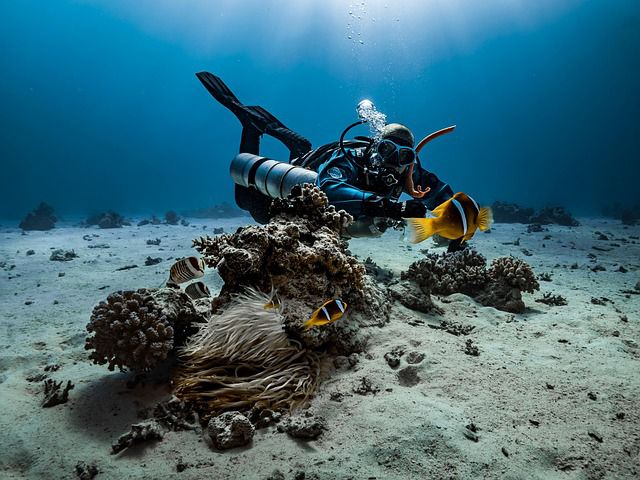
People ask this question hoping for reassurance. What they usually get is a dive centre saying "it's completely safe!" — which is both untrue and, if you think about it for two seconds, obviously untrue, because nothing is.
Here is the version we would want if we were asking.
What the data actually says
Published analyses of recreational diving fatality data put the rate at approximately 2 deaths per 100,000 dives.
That number needs context in both directions.
Why it might understate risk for some divers: it is an average across a very wide range of activity. Deep diving, technical diving, cave diving, solo diving and diving with untreated medical conditions all sit in that same pool.
Why it overstates risk for you specifically: a supervised introductory dive in shallow water with a professional at arm's length is at the safest end of everything that number covers. So is training under an instructor.
There is also a data limitation worth being honest about: there is no mandatory reporting of diving fatalities anywhere. The figures come from voluntary reporting and investigation, so they represent the best available picture rather than a complete census.
What actually goes wrong
This is the more useful question, because the answer is mostly actionable.
Analyses of diving casualties consistently group contributing factors into a small number of categories:
Pre-existing medical conditions. This is a big one, and cardiovascular disease is repeatedly identified as a substantial contributor — some analyses attribute around 15% of scuba fatalities to it. Many of these are events that would have been a risk on land too; the water simply removes your margin.
Procedural error. Running low on gas. Ascending too fast. Exceeding depth or time limits. Diving beyond certification or beyond current experience.
Environmental change. Conditions that were not what the diver expected — current, visibility, sea state, entanglement.
Equipment. Less common than people assume, and usually related to maintenance or unfamiliarity rather than sudden failure.
And the thing that is almost never on the list: marine life. Divers are not, as a category, hurt by animals.
What this means for you, practically
Most of the above is within your control. That is the genuinely reassuring part, and it is reassuring for a real reason rather than a marketing one.
Get the medical question answered properly
This is the single highest-value thing on the list, and the one most people skip.
If you have a heart condition, a lung condition including asthma, epilepsy, recent surgery, significant ear or sinus problems, or you are pregnant, get assessed by a physician with training in diving medicine before you book anything. Not a general practitioner unfamiliar with diving. Not a dive centre — we are not qualified to clear you, and any centre that tells you otherwise is telling you something dangerous.
The common questions — glasses, ear problems, asthma, age — are covered in glasses, ears, asthma, age.
Stay inside your certification
Every certification level carries a depth limit set by the training agency. Those limits are not commercial upsells. They exist because gas consumption, no-decompression time, narcosis and ascent complexity all change with depth.
The divers who get into trouble are very rarely the ones diving conservatively.
Do not lose currency and pretend otherwise
Skills degrade. A diver who certified three years ago and has not been in the water since is not, functionally, a certified diver — they are someone with a card. Refresher sessions exist for this and take an hour.
Choose the operator carefully
Ask direct questions and watch how they are answered:
- How old is the rental equipment, and when were the regulators last serviced?
- What is the emergency plan on the boat?
- Where is the nearest recompression facility and how would you get me there?
- What is the diver-to-guide ratio?
A professional operation answers these immediately. Hesitation is information.
The fear itself
Separately from risk: a lot of people asking this question are not really asking about statistics. They are asking whether the feeling of being underwater with something in their mouth is going to be unbearable.
Honestly: for a small number of people, the first attempt is unpleasant. Breathing underwater contradicts a fairly fundamental instinct, and the first descent can feel wrong before it feels good.
What helps:
Say it out loud before you get in. An instructor who knows you are anxious runs the session differently — slower, shallower first, more time on the surface. An instructor who does not know is working blind.
Start in shallow water and stay there until it is boring. There is no prize for descending fast.
Know that you can end it at any moment. You are never trapped. Going up is always available in the shallow water where you start.
Understand that the mask and regulator are the hardest part, and they are on the surface. Most of the discomfort people fear happens in the first two minutes, in water they can stand up in.
Diving in Lebanon specifically
The risk factors here are the same as anywhere, with a couple of local notes.
Conditions are variable. This coast changes with rain, run-off and swell. A good operator cancels; a bad one goes anyway. Being told a dive is off is a sign of a centre worth diving with.
Several of Lebanon's best sites are deep. The Souffleur at 38–40 m and Shark Point at 34–38 m are advanced dives. There is a natural temptation to reach for them early. Do not.
Ask about emergency provision. It is a fair question anywhere and a reasonable one to ask here.
So — is it safe?
It is a risk activity with a low absolute rate of serious incidents, in which a large proportion of the risk is concentrated in identifiable behaviours: diving with an undiagnosed medical condition, exceeding your training, running out of gas, ascending badly, and diving with operators who cut corners.
Avoid those five things and you are in the safest part of an already fairly safe distribution.
That is not "don't worry." It is better than "don't worry," because you can act on it.
If you want to know what the experience actually feels like minute by minute, that is your first dive, minute by minute. If you are ready to try it in shallow water with someone next to you, that is try scuba in Beirut.