Every dive centre in Beirut gets the same question, usually within about a minute of someone hearing the name: are there actually sharks?
Short answer: sometimes, in summer, and they are harmless. Longer answer: the sharks are the least interesting thing about this site, and the name has done it a slight disservice.
The site
| Location | Approx. 12 km south of Ras Beirut |
| Access | Boat |
| Average depth | ~34 m |
| Maximum depth | ~38 m |
| Current | Can be significant |
| Visibility | Roughly 6–25 m depending on season and conditions |
| Level | Advanced, deep-certified, current deep experience |
| Best conditions | Spring and autumn; summer for the sand tigers |
What it's actually like
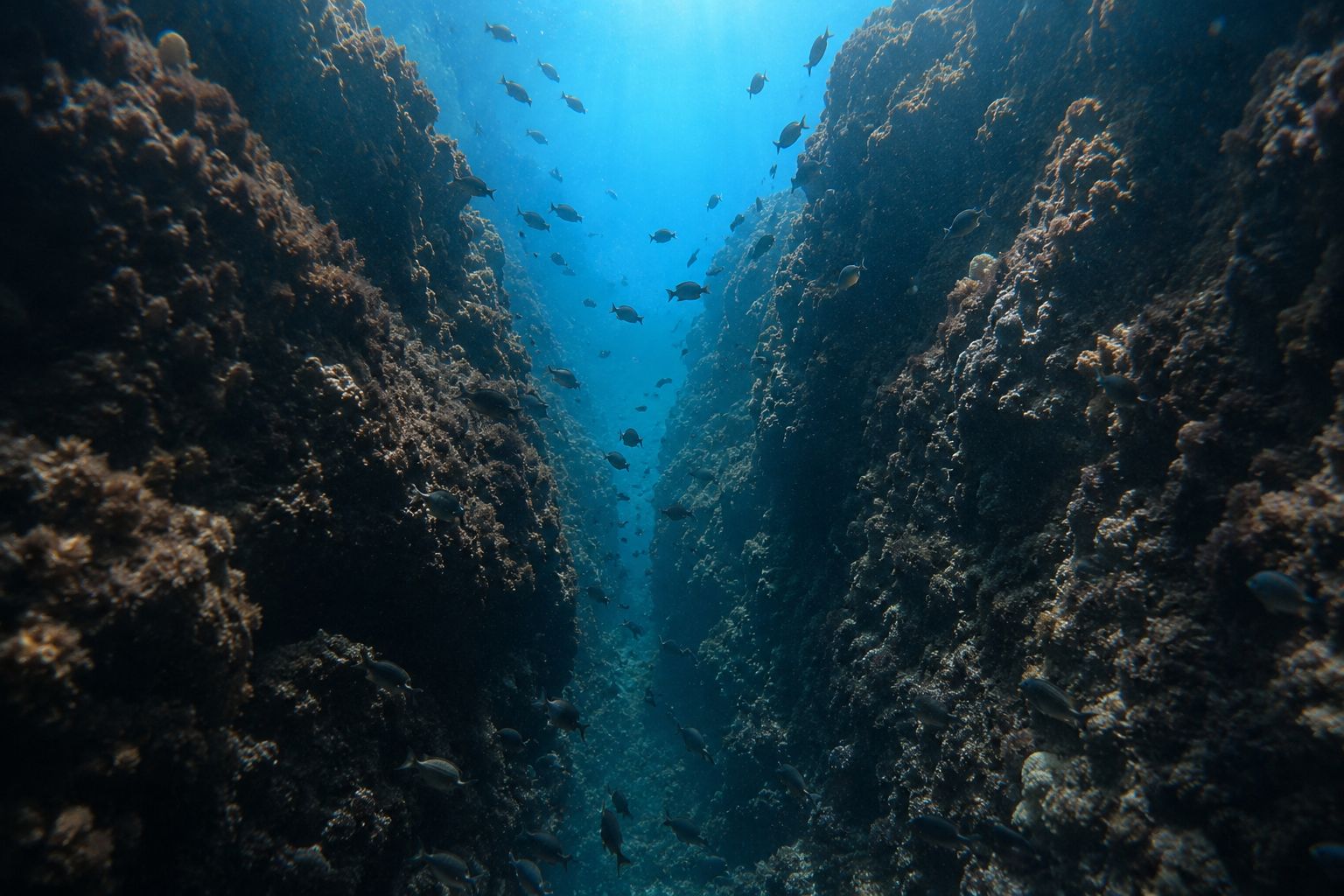
This is a deep, open-water site with real topography and real water movement. You go in off a boat, you go down, and the site is not something you meander through — it is something you dive with intent, because at 34 metres average the clock is not generous.
The current is the defining variable. On a slack day it is a straightforward deep dive. On a running day it changes how you plan the entry, how you work the site and how much gas you use — and a strong current at 35 metres is a genuinely different proposition from a strong current at 15.
The marine life
Rays
This is what the site should probably be named after. Stingrays on the sand and eagle rays in the water column are the reliable draw here, and for a lot of divers a big ray passing at depth in blue water is a better memory than any shark.
Morays
In the rock structure, as everywhere on this coast, and often out and moving more than at shallower sites.
The sharks
Smalltooth sand tiger sharks are reported here, mostly in July and August.
A few things worth being clear about. They are slow, heavy-bodied and not interested in divers. The species is related to the grey nurse — the shark that looks alarming in photographs and has an unremarkable safety record. And crucially, sightings are not reliable. Some summers people see them repeatedly; some summers they do not.
Everything else
Structure-associated fish across the site — bream, damselfish, wrasse, and the grouper that hold territory anywhere there is decent relief on this coast. Full breakdown in what you'll actually see underwater in Lebanon.
Diving it well
Plan the dive around the current, not the site. Where you enter and which direction you work depends entirely on what the water is doing that morning. This is the operator's job and a good one will brief it properly.
Watch your gas early. At 34 metres with current, consumption is dramatically higher than most divers estimate. Check earlier and more often than feels necessary.
Nitrox helps. Not for depth — for nitrogen loading, especially on a two-dive day. See nitrox in Lebanon.
Carry a surface marker and know how to deploy it. On a current site, surfacing away from the boat is a normal outcome, not an emergency — provided you can be seen.
When to dive it
Spring and autumn give the best all-round conditions — settled sea, decent visibility, manageable current.
July and August is when the sand tigers are reported, and also when the water is warmest. It is not automatically the clearest.
Winter happens, but this is an exposed offshore site and it gets blown out often.
Month-by-month detail in when to dive in Lebanon.
Where it fits in a Beirut dive day
Shark Point is a first-dive-of-the-day site. Deep, current-prone, and better with your full no-decompression time available. A shallower site around Raouché or a reef stop makes the natural second dive.
How a Beirut boat day runs generally — timings, what to bring, how the schedule works — is in boat dives from Beirut.
If you are not ready for it yet
That is a perfectly normal answer, and Shark Point will still be there. The route is advanced training, a run of ordinary dives to make depth feel unremarkable, and then this site with attention to spare.
The other Beirut sites are in scuba diving in Beirut, and the full coastal picture is in every dive site on the Lebanese coast.