Divers who learned in the Red Sea or Southeast Asia get in the water in Lebanon and, for about ten minutes, think there is nothing here.
Then somebody points at a rock and the rock turns out to be an octopus.
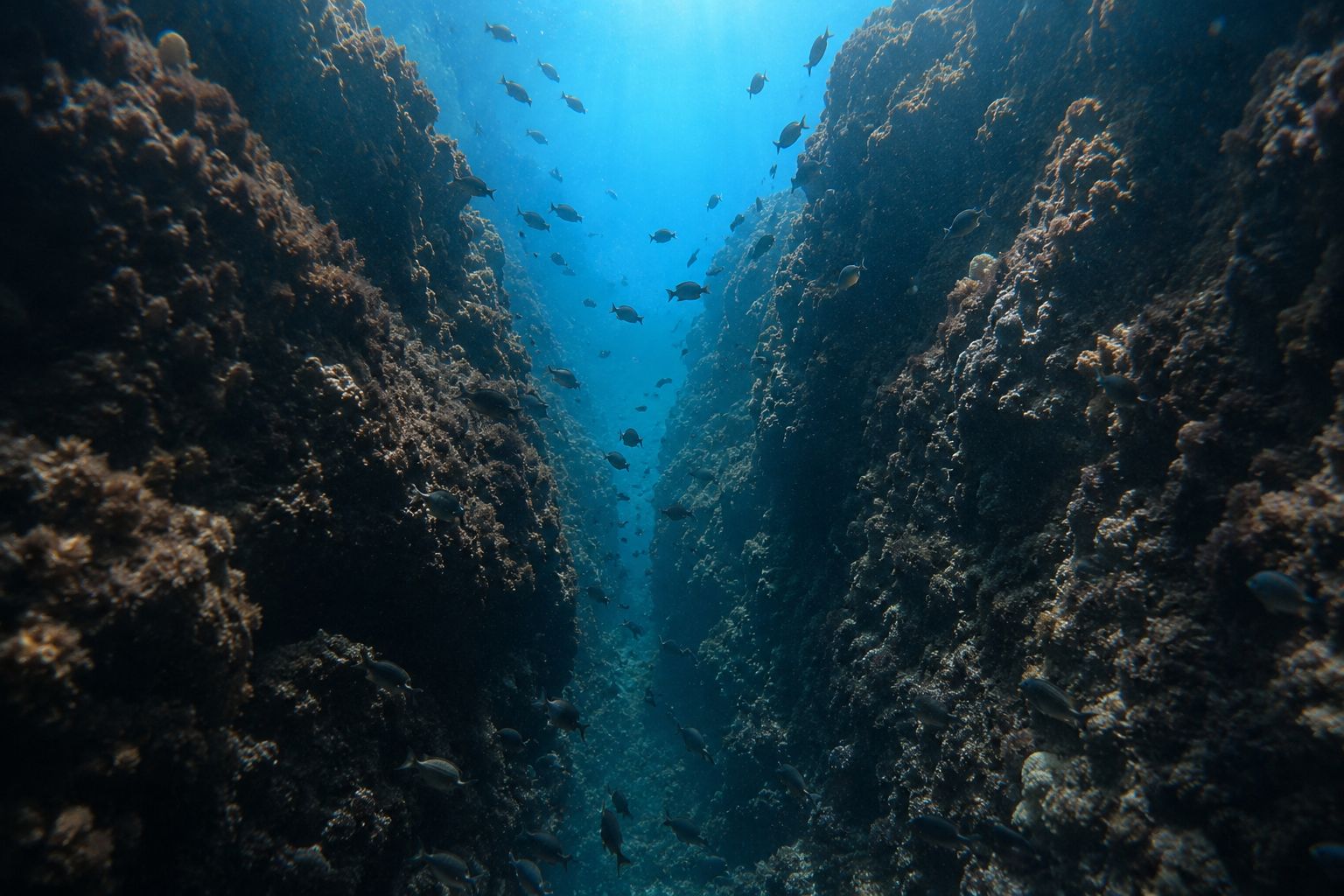
The Eastern Mediterranean does not announce itself. It is a nutrient-poor sea with clear water and comparatively low biomass, and it does not do the wall-of-fish spectacle that tropical reefs do. What it does instead is reward attention — and divers who make that adjustment tend to end up preferring it.
Here is what is actually down there.
The ones you will almost certainly see
Octopus
Common, and once your eye adjusts, everywhere. They live in holes in the rock, usually with a scatter of shell fragments outside the entrance — the giveaway that guides look for. Watching one change colour and texture against the rock is, for a lot of divers, the single best thing about diving here.
Moray eels
A fixture of Mediterranean rock and wreck structure. Head out of a hole, mouth opening and closing — which is breathing, not aggression. They are not a threat unless someone puts a hand somewhere it does not belong. Nobody should be putting a hand anywhere.
Bream, damselfish and wrasse
The workaday reef fish of the Mediterranean, in numbers, over almost every site. Damselfish in dark clouds over the structure. Various bream species picking over the rock. Wrasse in colours that surprise people who think the Med is grey.
Grouper
The fish that makes a wreck dive. Groupers hold territory around structure and, on sites that are not heavily fished, the same individuals occupy the same spots dive after dive. On the Alice B and the Souffleur they are part of what people come back for.
The ones worth hoping for
Rays
Stingrays on the sand, and eagle rays in the water column at some sites. Sand-bottom sites near the wrecks are where most ray encounters happen.
Sharks
Smalltooth sand tiger sharks are reported at Shark Point south of Ras Beirut, typically in July and August. This is a slow, heavy-bodied species that poses no meaningful risk to divers.
Two honest caveats: sightings are not reliable, and anyone selling you a shark dive in Lebanon is overselling. Treat it as a possibility, not an itinerary. More on the site itself in Shark Point, Beirut.
Nudibranchs and small stuff
The Mediterranean is genuinely good for small subjects — nudibranchs, shrimp, blennies, small crustaceans in the rock. Macro photographers who arrive expecting nothing tend to leave with full cards.
What has changed — and it has changed a lot
The Levantine Sea is the fastest-changing part of the Mediterranean, and any honest marine life guide has to say so.
Species from the Red Sea have been entering the Mediterranean through the Suez Canal for over a century, and the rate has increased. The Eastern Mediterranean — Lebanon squarely included — is where they arrive first and establish most successfully. Warming water has accelerated it.
What this means for a diver:
- You will see species here that are not "Mediterranean" in the textbook sense. Rabbitfish, lionfish and pufferfish among them.
- Some of them matter for safety. Lionfish have venomous spines. Certain pufferfish species carry potent toxins. The rule is the same as everywhere: look, do not touch, do not handle.
- Some of them matter ecologically. Established newcomers compete with native species, and the composition of these reefs is not what it was thirty years ago.
Life on the wrecks specifically
A wreck on a sand plain is a concentration point. Everything that needs hard structure is on it, because there is nothing else for hundreds of metres.
The Alice B has been the subject of a peer-reviewed study of exactly this — the community of organisms that colonises a modern shipwreck in the nutrient-poor Levantine Sea. The finding a diver cares about is simple: given enough time, a steel hull becomes a functioning reef, and in a sea with limited natural hard substrate that matters more than it would elsewhere.
Practically, on a Lebanese wreck: encrusting growth over most surfaces, grouper on the structure, morays in the openings, schooling fish over the high points, and whatever lives on sand along the hull line.
Seasons
Marine life here follows the water.
| Period | What changes |
|---|---|
| Late spring | Water warming, activity increasing, visibility often good |
| Mid summer | Warmest water, peak fish activity, sand tiger reports at some sites |
| Autumn | Warm water still, settled sea, often the year's best visibility |
| Winter | Cooler, quieter, more weather cancellations, but clear on good days |
Month-by-month water temperature and conditions are in when to dive in Lebanon.
What you will not see
Saying this plainly is more useful than another paragraph of enthusiasm.
You will not see tropical coral gardens. You will not see turtles reliably. You will not see large schooling pelagics as a matter of course. You will not see the density of fish that an image search for "scuba diving" puts in your head.
What you will see is a temperate sea with clear water, real structure, genuinely interesting animals, and — crucially — almost nobody else in it.
Getting better at seeing it
Dive with someone local. A guide who dives a site weekly knows which hole the octopus is in. That is not romance, it is pattern recognition built over hundreds of dives.
Get your buoyancy sorted. You cannot hover and watch if you are finning to hold depth. This is the real reason experienced divers see more.
Bring a light, even in daylight. Mediterranean rock at 25 metres is monochrome without one and full of colour with one.
Go at night, once. The same site becomes a different place — octopus out hunting, crustaceans everywhere, sleeping fish you can approach.
If you are starting from scratch, the Open Water course is the entry point, and snorkelling will show you the shallow version in the meantime.