If you only dive one wreck in Lebanon, dive this one. Not because it is the most historically significant — that is the Souffleur — but because the Alice B is the one where you actually get to look at a shipwreck instead of watching your gas and your no-decompression time drain away.
The site
| Location | Jounieh Bay, north of Beirut |
| Type | Cargo ship, upright on sand |
| Depth | Deck around 27 m, seabed around 37 m |
| Approximate length | ~50 m |
| Access | Boat |
| Level | Advanced recreational, deep-trained |
That 27-to-37-metre spread is the whole reason this site works as a first wreck. On a wreck that sits flat at 40 metres, everything you came to see is at the limit. Here the superstructure comes up to a depth where an advanced diver has real, usable bottom time.
The dive
You descend into blue and the hull resolves out of it — which on a good day in Jounieh happens earlier than you expect, and on a bad day happens about five metres above the deck.
The standard profile works the shallower structure first and drops to the sand later, which is both the sensible gas plan and the sensible decompression plan. Working deep-to-shallow across a wreck with a 10-metre vertical spread is one of the more genuinely satisfying dive profiles available in Lebanon: you are always ascending slightly, always extending your time.
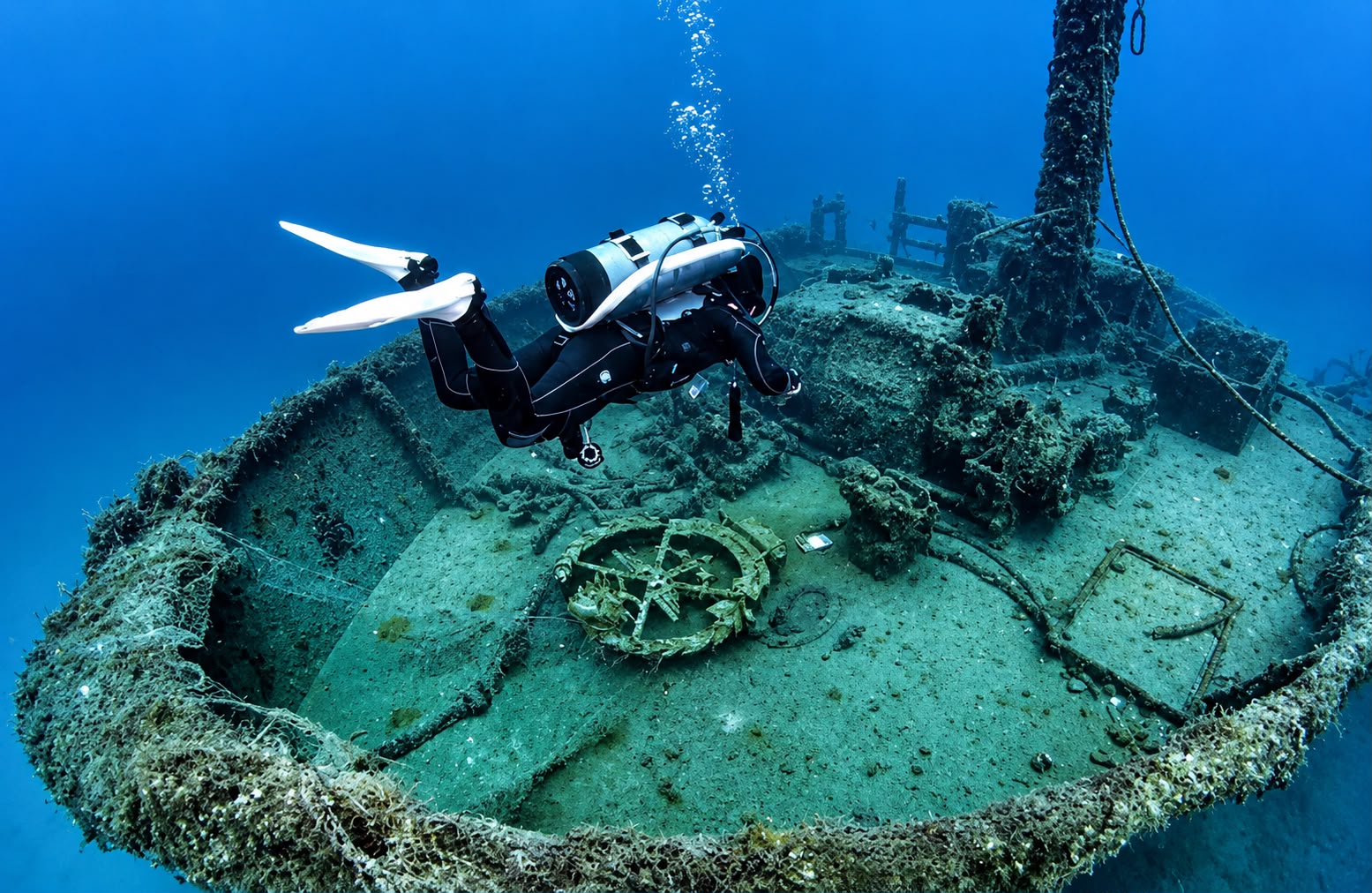
The hull is the obvious feature — a full ship's shape, upright, legible. The sand line is where you find whatever has fallen away and whatever lives underneath. The high points are where the fish are.
That last point is more than decoration. The Alice B was included in a peer-reviewed study of epibenthic communities on modern shipwrecks in the Levantine Sea — the science of what colonises a wreck in a nutrient-poor sea. When divers say a wreck "has become a reef," this is a case where somebody actually measured it.
How she got there
Here the article has to slow down, because the internet does not.
What sources agree on: the Alice B was a cargo vessel, she went down in Jounieh Bay during the Lebanese civil war period, and she now lies upright on sand in the depths given above.
What sources disagree on: the year. 1980 and 1984 both appear in published listings.
What circulates as local account: that she was scuttled deliberately, with the loss framed as an accident for insurance purposes. This story is well known among Lebanese divers and appears in several diving write-ups. We have not been able to trace it to a primary source or a court record.
Who this dive is for
If you are not there yet, the route is short: advanced training plus a run of ordinary dives in Jounieh and around Beirut. Twenty relaxed dives change what you get out of a wreck more than any certification card does.
Practical notes
Nitrox is worth it here. At a 27–37 m profile, enriched air meaningfully changes your nitrogen loading, particularly if you are doing a second dive afterwards. See nitrox in Lebanon.
Watch for line and net. Fishing gear collects on Mediterranean wrecks. Carry a cutting tool, know where it is, and do not swim into anything you have not looked at properly.
Thermal protection. The surface reading is not the wreck reading. At the bottom, in Jounieh, most divers want more suit than they expected — particularly on a second dive. Wetsuit guidance here.
Conditions. Jounieh is a sheltered bay, which means it is often divable when exposed sites are not. Visibility follows the same pattern as the rest of the coast — best in late summer and autumn, worst after rain.
Where it fits
The Alice B is step one of Lebanon's wreck progression. From here the path runs to the Batroun wrecks in clearer northern water, then to the Souffleur at the recreational edge, and then — for a very small number of divers — into technical territory.
The complete picture is in wreck diving in Lebanon.