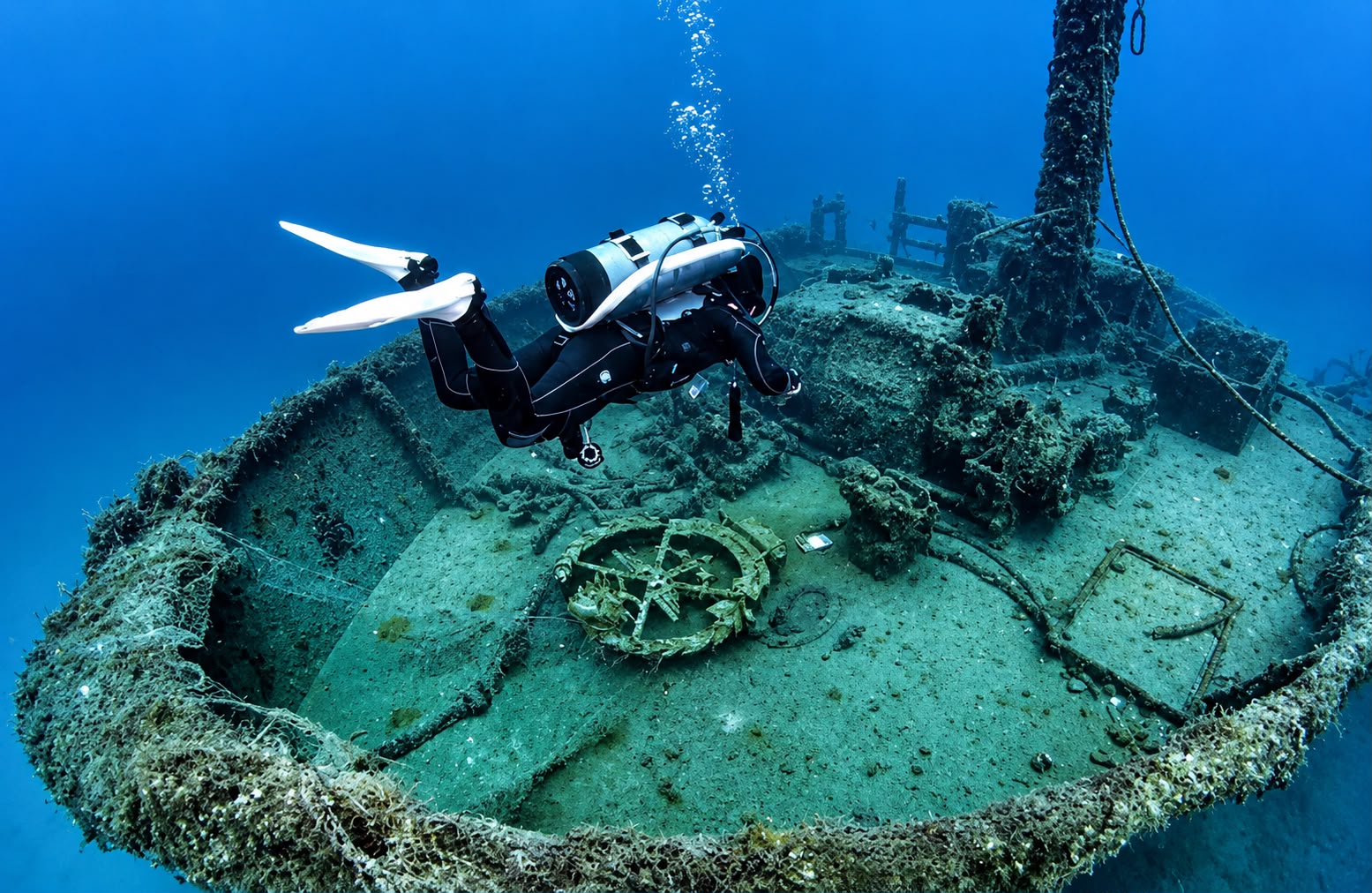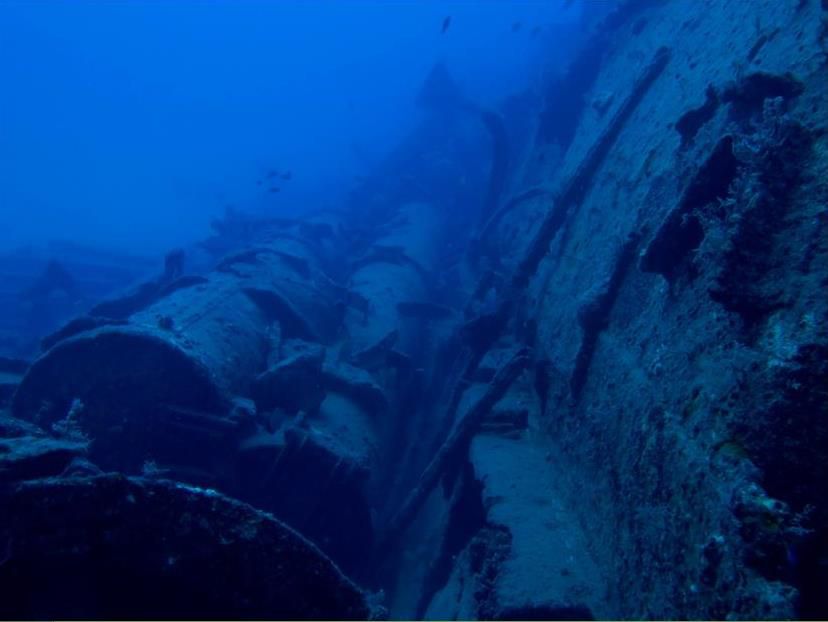
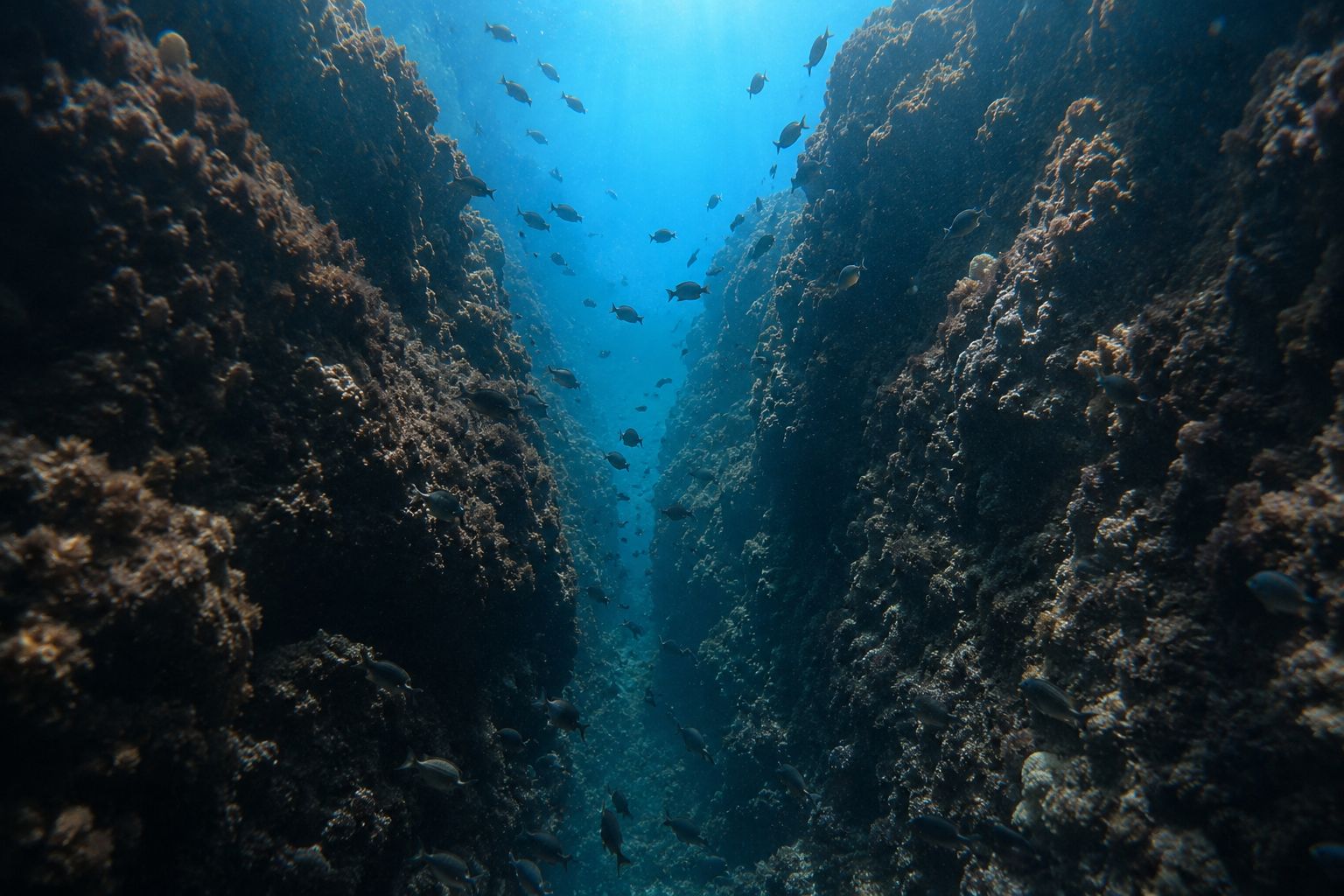
Lebanon's coastline is about 220 kilometres long. You can drive the whole thing in an afternoon with a stop for coffee. What is underneath it is disproportionate to that: a Victorian battleship, a Second World War submarine, civil-war cargo ships, natural caves, canyon topography and walls — most of it dived by a handful of people.
This is the site-by-site version, arranged geographically from south to north, with the two things guides usually omit: the depth you will actually be at, and the certification level you actually need.
Beirut and Raouché
The city coastline is where most Lebanese divers learn, and it is more interesting than a capital city's shoreline has any right to be.
The Raouché rock formations
Beirut's landmark sea stacks continue below the surface. The topography here is rock: arches, cuts, boulder fields and small swim-throughs, generally in the shallow-to-moderate range. It is the standard training and check-out area for Beirut-based centres, which means it is also where most people in this city took their first breath underwater.
Level: entry-level and up. Character: structure, light, easy profiles.
More on the caves and rock formations specifically in the Riviera caves and Beirut's underwater rock formations.
Shark Point
About 12 km south of Ras Beirut, reached by boat. Published figures put it at an average of around 34 m with a maximum near 38 m.
The name causes more confusion than it should. Sightings reported here in July and August are of smalltooth sand tiger sharks — a species that poses no meaningful threat to divers and which nobody should expect to see on a given dive. The site is better known day-to-day for rays, morays and the fish that gather on the structure.
It is an advanced site. Currents can be significant.
Level: advanced, deep-certified. Full write-up: Shark Point, Beirut.
Khaldé — the Souffleur
Roughly 5 km off the coast south of Beirut sits the French submarine Souffleur, torpedoed on 25 June 1941 and broken into two sections on the sand at approximately 38–40 metres.
This is the dive most experienced divers in Lebanon would name first. It is also firmly an advanced dive at the edge of recreational limits, with short bottom times and real gas-planning consequences.
Level: advanced with deep training and current deep experience. Full write-up: the Souffleur.
Jounieh Bay
The Alice B
A cargo ship lying on sand in the bay north of Beirut. Published depths put the deck at around 27 m and the bottom at around 37 m, with the hull roughly 50 m long.
The Alice B is Lebanon's most accessible real wreck. Enough of it is in the shallower part of the recreational range that a competent advanced diver can get a proper wreck experience without operating at the limit.
Level: advanced recreational. Full write-up: the Alice B.
The bay generally
Jounieh is sheltered, which matters on this coast — it is often divable when more exposed sites are not. Reef and rock diving around the bay covers a range of depths suitable from entry level upwards. More in diving from Jounieh and the bay.
Batroun and the north
This is where Lebanon's water gets clear. The northern coast is further from Beirut's run-off and development, and divers consistently report the country's best visibility here.
The cement freighter (Captain Michel)
A cargo vessel that went down carrying cement, resting on a sandy bottom at around 40 m, with the shallower structure at around 35 m. The cargo is still recognisable on the wreck.
Accounts of exactly how and when she sank vary between sources, and we treat the circumstances as local account rather than documented record.
Level: advanced, deep-certified. Penetration only with specific wreck training.
St Catherine cavern and the Air Cave
North of the cement wreck, the coast has genuine overhead environments. St Catherine is a cavern requiring overhead-environment certification. The Air Cave is a shallower passage that ascends towards the surface.
Full regional guide: diving Batroun and the north.
Off Tripoli — HMS Victoria
Approximately 8 km offshore, in about 140 metres of water, the Royal Navy battleship HMS Victoria stands vertically with her bow buried in the seabed.
She is beyond recreational limits, beyond ordinary technical limits, and is a protected war grave. She is included here because people ask about her constantly and deserve a straight answer: you cannot dive this wreck.
Full write-up: HMS Victoria.
Quick reference
| Site | Area | Depth | Level | Access |
|---|---|---|---|---|
| Raouché formations | Beirut | Shallow–moderate | Entry-level+ | Shore / boat |
| Shark Point | 12 km S of Ras Beirut | ~34–38 m | Advanced | Boat |
| Souffleur submarine | Khaldé | ~38–40 m | Advanced + deep | Boat |
| Alice B | Jounieh | ~27–37 m | Advanced | Boat |
| Cement freighter | Batroun | ~35–40 m | Advanced + deep | Boat |
| St Catherine cavern | Batroun | Cavern | Overhead cert. | Boat |
| HMS Victoria | Off Tripoli | ~140 m | Not divable | — |
What conditions are actually like
Two things dominate diving conditions in Lebanon.
Rain and run-off. Visibility is at its best in late summer and autumn, after weeks without rain. Published visibility figures for Lebanese sites range from about 6 m to 25 m depending on source, site and season — that spread is not sloppy reporting, it is the actual variability. After a storm, expect the low end near the coast.
Sea state. This is an exposed coastline. Days get blown out. If you are visiting with fixed dates and specific sites in mind, build in spare days.
Water temperature runs from roughly 18 °C in late winter to around 29 °C at the peak of summer at the surface. Month-by-month detail is in when to dive in Lebanon.
Choosing a site as a newer diver
The honest advice: do not start with the deep wrecks.
If you have just certified, the Beirut and Jounieh rock and reef diving will teach you more than a 38-metre wreck where you will spend the whole dive watching your gauge. Get twenty or thirty relaxed dives in, add advanced training, then go and see the Souffleur properly.
What you'll see
Across all of these sites the marine life is Eastern Mediterranean: grouper holding station on structure, moray eels in the rock, octopus for those who look properly, bream and damselfish over the reef, rays on the sand. It is not a coral reef and it does not pretend to be.
We go through it species by species in what you'll actually see underwater in Lebanon.