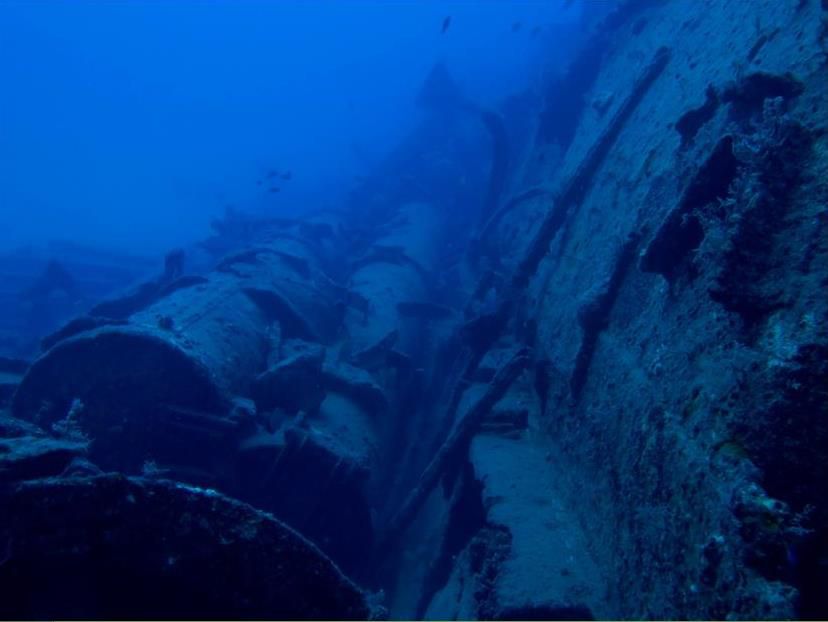
Most divers arrive at the Souffleur knowing one thing about it: there is a submarine down there. What makes the dive stay with people is usually the second thing — that she is in two pieces, and that the break is not damage from decades of sea. It happened in about the time it takes to read this paragraph, in June 1941, and fifty-odd men were inside.
The documented history
Souffleur was a Requin-class submarine of the French Navy, launched on 1 October 1924. She was 78.30 m long, with a beam of 6.84 m and a draught of 5.10 m — a large boat for her era, built for long-range patrol work.
In June 1940 France fell, and the French fleet split. Some vessels went to the Free French; others stayed loyal to the Vichy government. Lebanon and Syria were under Vichy administration, and in June 1941 Allied forces launched the Syria–Lebanon campaign to take them.
On 25 June 1941, the British submarine HMS Parthian torpedoed Souffleur off the Lebanese coast, at approximately 33°49′N 35°26′E. She broke in two and went down.
The dive
| Location | Off Khaldé, roughly 5 km south of Beirut |
| Depth | Approximately 38–40 m, on sand |
| Access | Boat |
| Level | Advanced / deep-certified, with real deep experience |
| Typical visibility | Often quoted at 15–20 m; genuinely variable |
| Best conditions | Late summer and autumn, settled sea |
What you'll see
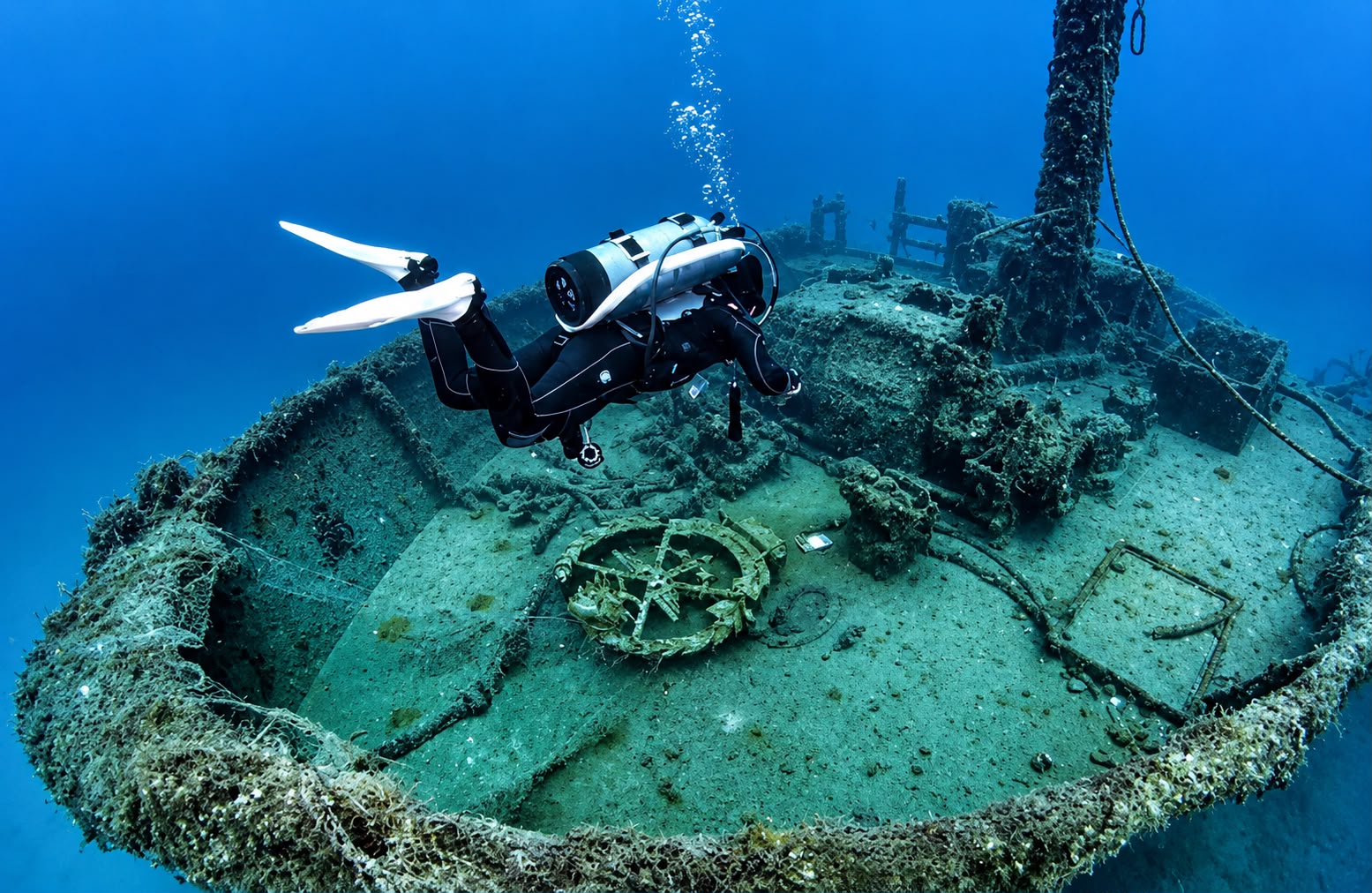
The wreck lies broken into two main sections on a sand bottom. Accounts of the site consistently describe a torpedo still in place in one of the forward tubes, deck armament, and buoyancy tank structure.
The conning tower area is the part most divers photograph. The break itself is the part most divers remember — a submarine hull is a very solid object, and seeing one opened is a different experience from seeing a cargo ship rusting apart.
Marine life follows the structure, as it always does on a sand-bottom wreck. Groupers hold position around the hull. Morays occupy the openings. Schooling fish gather over the highest points.
Why the depth matters more than it sounds
Forty metres is the recreational limit, and sitting at the limit changes the dive in ways that are easy to underestimate.
Your no-decompression time is short. On air at 40 m, usable bottom time is measured in a small number of minutes before you incur a decompression obligation. The dive is planned around that, not around how interesting the wreck is.
Gas consumption roughly quintuples. At 40 m you are breathing about five times the surface volume of gas per breath. A cylinder that gives an hour in shallow water gives a fraction of that here.
Nitrogen narcosis is a real factor at this depth for most people. It is not dramatic, usually — it is a subtle narrowing of attention exactly when a diver most needs to be tracking depth, gas and time.
Ascent discipline is not optional. A controlled ascent with a proper safety stop matters at every depth and matters more here.
This is why enriched air nitrox is worth holding before you dive the Souffleur regularly. It does not let you go deeper — the oxygen content restricts depth rather than extending it — but on a repetitive-dive day it meaningfully changes your nitrogen loading.
Conditions in Lebanon
The Souffleur is a settled-sea dive. Lebanese coastal conditions are generally best in late summer and autumn, when there has been no rain for weeks and the water has calmed. After winter storms or heavy rainfall, run-off can cut visibility significantly along this stretch of coast.
Water temperature at depth runs cooler than the surface reading, and at 40 m for a short bottom time followed by a slow ascent, most divers want more thermal protection than the surface temperature suggests. Our month-by-month breakdown is in when to dive in Lebanon, and wetsuit choice is covered in what wetsuit you need for Mediterranean water.
A war grave, not an attraction
Men died on this submarine. Whatever the exact number, they are still there.
The diving convention on war graves is simple and worth stating: look, photograph, take nothing, move nothing, and behave the way you would in any other place where people are buried. Lebanon's wrecks have been picked over more than they should have been, and every artefact removed is one fewer reason for the next diver to come.
Where the Souffleur sits among Lebanon's wrecks
She is the historically significant one that is actually divable. HMS Victoria is more famous and sits at 140 m, entirely out of reach. The Alice B off Jounieh is shallower and far more accessible. The Batroun wrecks sit in between, in clearer northern water.
The full picture is in wreck diving in Lebanon.
Booking it
Tell the dive centre your certification level and how many dives you have logged below 30 metres in the last twelve months. A good operation will use that to decide whether to take you, and will not be offended by the question going the other way — ask them how they run the dive, what the gas plan is, and what happens if someone has a problem at depth.
On a settled day, with a diver who is ready for it, the Souffleur is the best dive in Lebanon.