Countries build tourism industries on one good wreck. Lebanon has a submarine torpedoed in 1941, a Royal Navy flagship standing vertically in 140 metres, cargo ships from the civil war, and a pre-war freighter still carrying its cement — inside 220 kilometres of coastline that most of the diving world has never considered.
The reason nobody knows is not mystery. It is that Lebanon spent the decades when Mediterranean dive tourism was being built doing other things.
Why there are so many
Three overlapping histories put ships on this seabed.
Naval history. The Eastern Mediterranean was a strategic theatre in both world wars and before them. HMS Victoria was lost during Royal Navy fleet manoeuvres in 1893. Souffleur was sunk during the 1941 Syria–Lebanon campaign, a piece of the Second World War that gets a paragraph in most histories.
Commercial traffic. This coast has been a trading route for several thousand years. Ships have been going down on it for as long as there have been ships.
The civil war. Between 1975 and 1990 the normal rules governing shipping, insurance and salvage did not straightforwardly apply. Several of the wrecks divers visit today entered the water in that period, and the circumstances of some are, to put it carefully, contested.
The wrecks, by what you need to dive them
Within reach of an advanced recreational diver
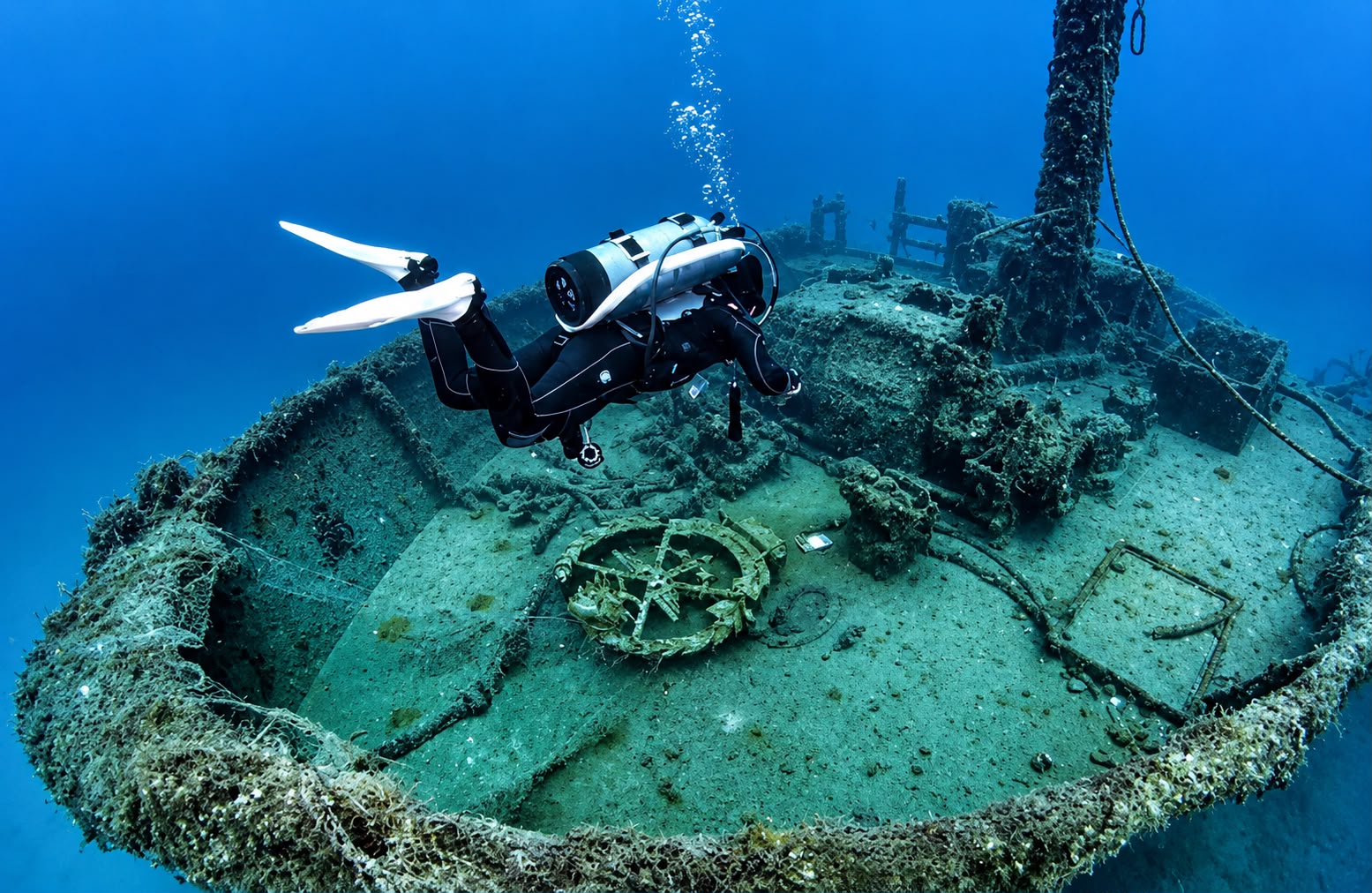
The Alice B — Jounieh. A cargo ship on sand, deck at around 27 m, bottom around 37 m, roughly 50 m long. This is the wreck to start on. Enough structure to feel like a proper wreck dive, shallow enough at the top that you get real bottom time. It has also been studied scientifically as an artificial reef, which tells you something about how thoroughly the sea has adopted it. Full write-up.
The cement freighter (Captain Michel) — Batroun. Sandy bottom at around 40 m, shallower structure around 35 m, cargo still visible. Northern water means better visibility than most of the coast. Deep-certified divers only.
At the edge of recreational limits
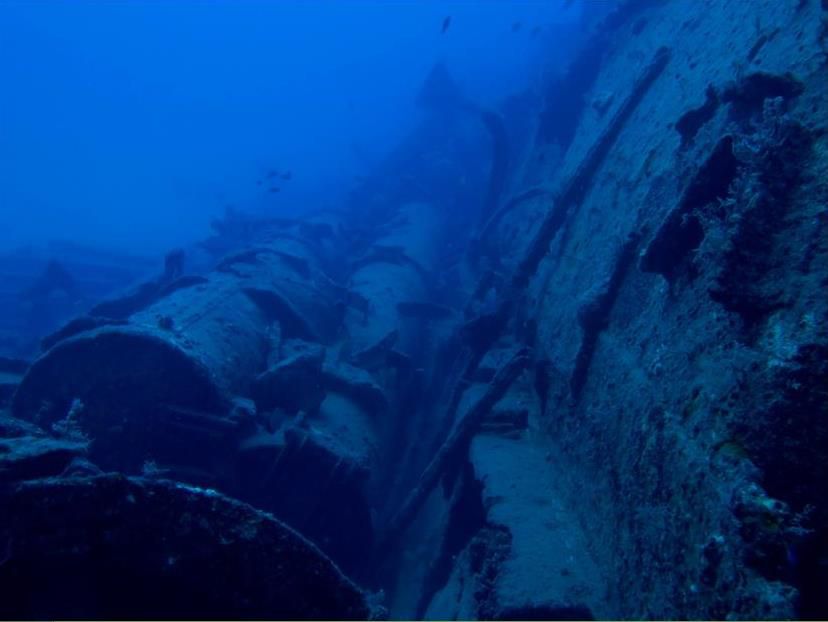
The Souffleur — Khaldé. The Requin-class French submarine torpedoed by HMS Parthian on 25 June 1941, lying broken in two at roughly 38–40 m. This is the historically significant dive that is actually possible. It demands advanced certification, deep training and current experience. Full write-up.
Beyond any recreational limit
HMS Victoria — off Tripoli. In approximately 140 metres, standing vertically with about 30 metres of bow buried in the seabed. 358 people died when she went down on 22 June 1893. Found in 2004. Not divable by any recreational or ordinary technical standard. Full write-up.
Wreck diving is a skill, not a destination
The single most useful thing to understand: diving around a wreck and diving inside one are different disciplines.
Outside the wreck
You need a certification covering the depth, good buoyancy, and awareness of entanglement hazards — fishing line and net on Mediterranean wrecks is common and is the most likely thing to actually cause you a problem. A cutting tool is standard. So is not touching things.
Inside the wreck
Penetration means an overhead environment: no direct ascent to the surface. That changes everything. It requires wreck-penetration training, continuous guideline use, redundant lights, redundant gas, and a level of buoyancy control where you can move through a corridor without stirring the silt that will take your visibility to zero.
Conditions and marine life on Lebanese wrecks
A wreck on a sand bottom is an oasis. Everything that needs structure moves onto it.
On Lebanese wrecks that means grouper holding territory, moray eels in openings, schooling fish over the highest points, and encrusting growth across the hull. The PLOS ONE study of the Alice-B looked at exactly this — the community of organisms that colonise a modern shipwreck in the nutrient-poor Levantine Sea.
What this means practically: the wreck is the reason you came, but the reason to slow down is what has grown on it. Divers who swim the length of a wreck and back see a fraction of what divers who pick one section and stay there see.
More in what you'll actually see underwater in Lebanon.
Building towards the wrecks
If wreck diving is why you are learning, here is the realistic sequence.
- Open Water certification. The foundation. Nothing else happens without it.
- Twenty to thirty relaxed dives. Not glamorous. This is where buoyancy stops being something you think about.
- Advanced training with a deep component. Extends your working depth and, more importantly, your judgement at depth.
- Enriched air nitrox. On 35–40 m wrecks this genuinely changes your day, particularly on repetitive dives.
- Wreck specialty training if you want to go inside.
- Technical training only if the interest is real and sustained.
Diving them responsibly
Lebanon's wrecks are finite and some have already been stripped. The rules are not complicated:
- Take nothing. Not a plate, not a fitting, not a piece of the cargo.
- Move nothing. What looks like debris is often what makes a site legible to the next diver.
- Treat war graves as graves. People died on the Souffleur and on HMS Victoria.
- Report entanglement hazards to the operator so they can be dealt with.
The short version
Lebanon has more good wreck diving than almost anyone realises, at a range of levels from accessible to impossible. Start on the Alice B, work towards the Souffleur, and understand that HMS Victoria is history rather than an itinerary.
Site-by-site depths and levels for everything on this coast are in every dive site on the Lebanese coast.