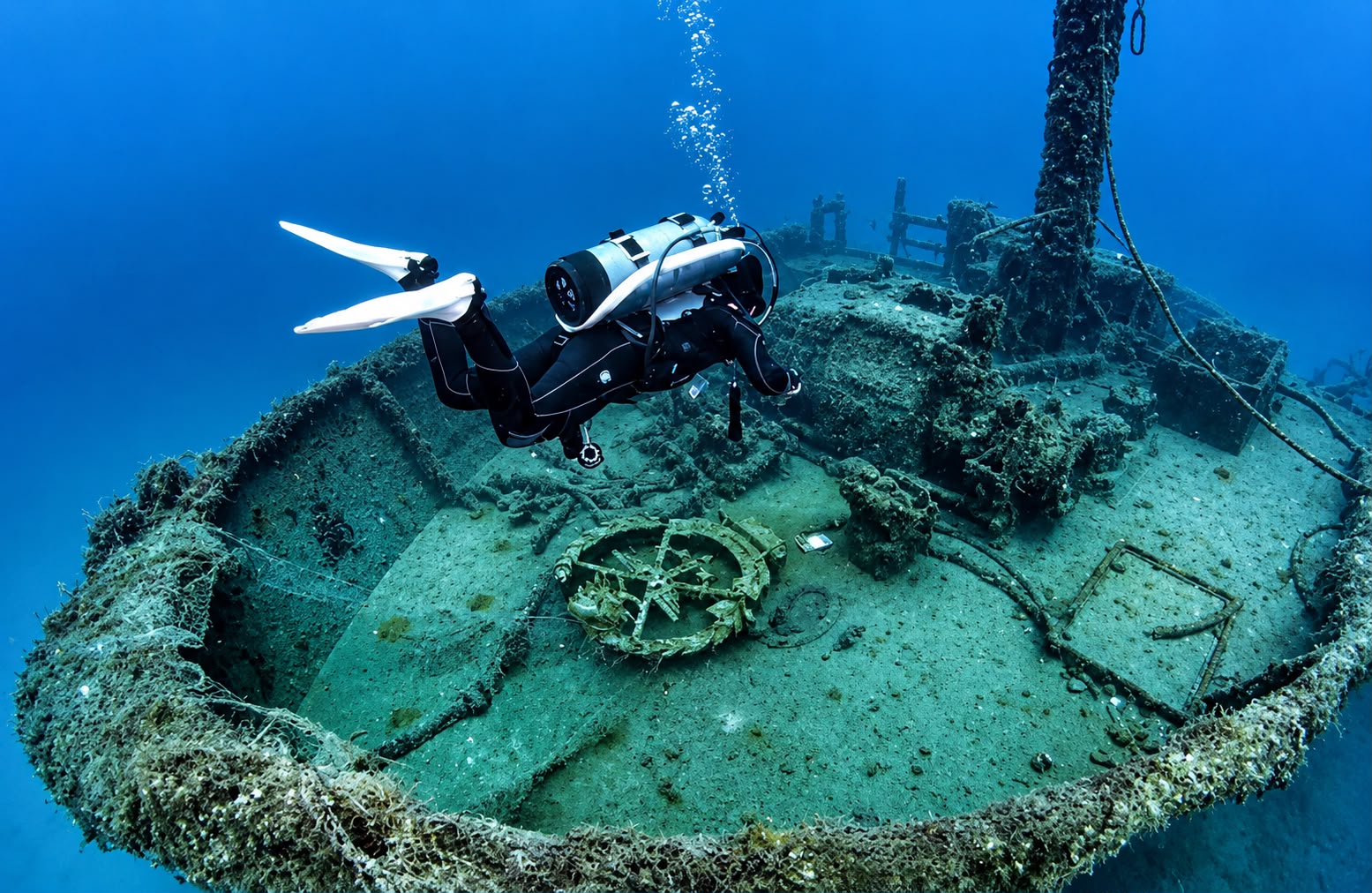
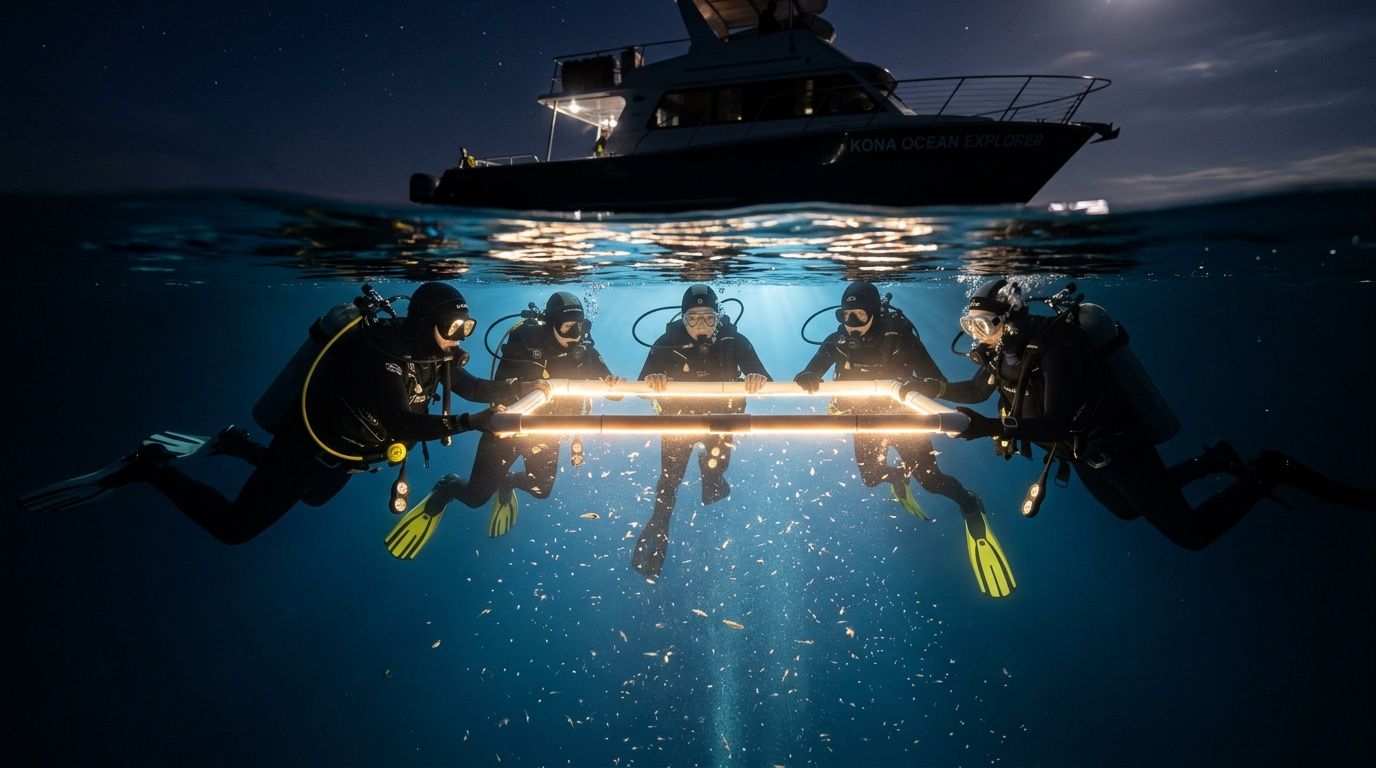
Recreational diving stops at 40 metres. Lebanon's seabed does not.
There is a real technical diving conversation to have about this coastline, and it is not the one that usually gets had — which tends to involve depth numbers and photographs of people wearing a lot of equipment. The useful conversation starts with what technical diving actually is, and ends with an honest assessment of whether you should do it.
What technical diving actually means
One thing separates technical from recreational diving: a direct ascent to the surface is no longer available.
That is the whole definition. Everything else follows from it.
You lose direct ascent in three ways:
- Decompression obligation. You have absorbed enough inert gas that surfacing directly would risk decompression sickness. You must stop on the way up, for a planned time, at planned depths.
- Overhead environment. A wreck interior, a cave, a cavern. There is a ceiling between you and the surface.
- Gas. You are breathing a mixture that is not safe to breathe at every depth in the water column.
Once any of those applies, everything changes: redundant gas supply, redundant regulators, redundant lights and computers, a specific equipment configuration, and a planning discipline where the dive is worked out on the surface and followed.
What is actually down there in Lebanon
Beyond recreational limits
HMS Victoria — approximately 140 m, off Tripoli. The Royal Navy flagship that sank in 1893 and stands vertically with her bow buried in the seabed. This is at or beyond the top of the published technical ladder. It is also a war grave and a protected site. It appears in this article because people ask, and the answer is that it is not a realistic objective. Full write-up.
Uncharted deep water generally. Lebanon's shelf drops away, and the wrecks that have been found are unlikely to be all of them — HMS Victoria herself was only located in 2004. There is genuine exploration potential here for divers with the training and, more to the point, the boat time and support.
At the recreational edge
The wrecks divers actually work towards — the Souffleur at 38–40 m, the Batroun cement freighter at 35–40 m, Shark Point at 34–38 m — are not technical dives. They are advanced recreational dives at the edge of the range.
This distinction matters, because a lot of divers assume they need technical training for these sites. They need advanced training, deep experience, discipline and probably nitrox. That is a very different and much shorter road.
The realistic progression
If you have read this far and still want it, here is the honest sequence. Note how much of it is not training.
| Stage | What it is | Realistic timeframe |
|---|---|---|
| Open Water | Entry-level certification | Days |
| Consolidation | 25–50 relaxed dives | Months |
| Advanced + deep | Extends working depth and judgement | Days, then more dives |
| Nitrox | Enriched air, better loading at depth | Short course |
| More consolidation | 100+ logged dives, comfortable at 30–40 m | Seasons, not weeks |
| Intro to tech / fundamentals | Configuration, trim, team skills | Days, then a lot of practice |
| Decompression procedures | Planned deco on open circuit | Course + supervised dives |
| Normoxic trimix | Typically to around 60 m | Course + supervised dives |
| Full / hypoxic trimix | Deeper again | Years into the progression |
Exact depth limits and course names vary by agency, which is itself a reason to ask a centre precisely what they teach and under which agency.
The honest case against
Most divers reading a technical diving article should not do technical diving. That is not gatekeeping, it is arithmetic.
It requires currency, not just certification. Technical skills degrade fast. A diver who does four technical dives a year is not a current technical diver, and the training does not make them one.
It requires infrastructure. Gas blending, cylinder servicing, appropriate boat support, and people to dive with at your level. In a small diving market these are real constraints, and they are worth checking before you invest in the training.
It costs a great deal. Equipment, gas, training, servicing. The equipment alone is a substantial multiple of a recreational setup.
The return is narrower than it looks. Lebanon's genuinely rewarding wrecks are mostly at 35–40 metres. Technical training opens water that is deeper, darker and — with the exception of exploration work — often less interesting per dive than the sites you can already reach.
If you do want to start
Ask the centre specific questions. Which agency? Which certifications do you actually run, this year? Who is the instructor and what is their technical background? How many students have you certified at this level? What is the gas supply situation?
Get your recreational diving genuinely solid first. Not "I have the cards" solid — "I can hold a stop in a current without thinking about it" solid.
Do a fundamentals-type course before committing to a decompression course. It is the cheapest way to find out whether you enjoy the precision or find it tedious. Divers who find it tedious should stop there, happily.
Get nitrox regardless. It is useful immediately, on dives you are already doing.
What most people should do instead
Get very good at the diving Lebanon already offers. Advanced training, nitrox, a wreck specialty, and a couple of hundred dives on this coast will give you more than a technical certification you exercise twice a year.
The wrecks are covered in wreck diving in Lebanon; the full site list with depths and levels is in every dive site on the Lebanese coast.