This is the qualification. Everything else in recreational diving either leads to it or follows from it.
An entry-level Open Water certification means you can rent equipment, join dives and dive with a buddy — in Lebanon, in Egypt, in Thailand, anywhere — without an instructor holding on to you. It does not expire. It is the single best-value thing in diving.
Here is what actually happens during it.
The three phases
Every recognised entry-level course has the same three components, whatever the agency calls them.
1. Academic
The theory: how pressure affects your body and your gas supply, why you ascend slowly, how to plan a dive within no-decompression limits, how equipment works, and what to do when things go wrong.
It is not difficult and it is not optional. Most of it is now done through digital materials at your own pace, which means you can complete it before you arrive. If you are visiting Lebanon on a fixed schedule, do this. It converts a four-day course into a three-day one and protects you against a weather day.
2. Confined water
Skill practice in a pool or shallow, pool-like conditions.
This is where you learn the things that make you safe rather than the things that make you comfortable:
- Clearing a flooded mask, and removing and replacing it
- Recovering a regulator that has come out of your mouth
- Sharing gas with a buddy from an alternate air source
- Controlled emergency ascent
- Buoyancy control — hovering, and controlling depth with your breathing
- Removing and replacing equipment at the surface and underwater
You repeat each of these until it is right. There is no clock on it.
3. Open water
Training dives in the sea, where you demonstrate the confined-water skills in real conditions and then — the actual point — go diving.
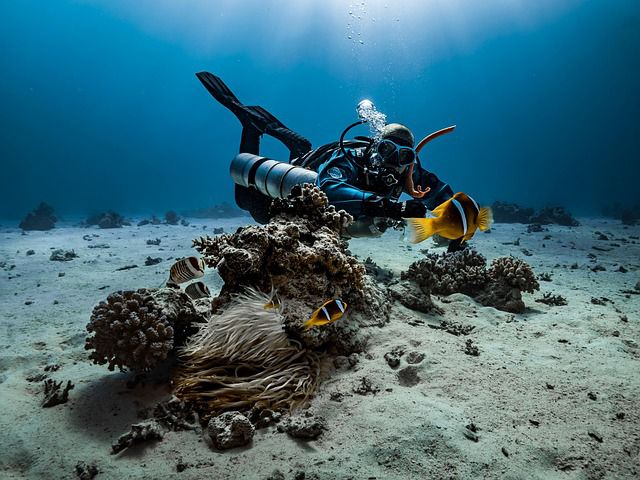
In Lebanon these typically happen along the Beirut coastline or in a sheltered bay, over rock and reef. You will see grouper, damselfish, morays in the rock, and probably an octopus. What's down there.
Timeline
| With theory done in advance | Starting from scratch | |
|---|---|---|
| Academic | Before you arrive | 1 day (or spread) |
| Confined water | Day 1 | Day 2 |
| Open water dives | Days 2–3 | Days 3–4 |
| Total on site | ~3 days | ~4 days |
Many centres also run it across consecutive weekends, which suits people who live here and works better for retention — there is a real argument that spacing the sessions produces a more comfortable diver.
Prerequisites
Age. Minimum ages are set by the agency, with junior certifications available at lower ages with reduced depth limits. Confirm the current threshold with your centre.
Swimming. There is a watermanship assessment — a continuous swim with no time limit or stroke requirement, plus a float or tread. It is a comfort check, not an athletic test. The full answer here.
Medical. A questionnaire, answered honestly. Some conditions require assessment by a physician trained in diving medicine before you can start. What's on it and what matters.
What a complete quote includes
Ask for these in writing. All of them.
- Instruction across all three phases
- Agency learning materials
- The certification fee
- All equipment for the duration of the course
- Air fills
- Boat access where training dives require it
- Confined-water facility access
And two questions that are not about money:
- How many students per instructor?
- What happens if I need an extra session — and is there a charge?
The honest breakdown of what drives price is in what diving actually costs in Lebanon.
Which agency
SEALS teaches SSI and NAUI. Both are internationally recognised; both produce certifications accepted by operators worldwide. The differences are real but smaller than the internet suggests, and the instructor matters more than the logo.
The full comparison is in SSI vs PADI vs NAUI.
What you can do afterwards
With an entry-level certification you can:
- Rent equipment anywhere in the world
- Dive with a buddy of similar or greater certification, without supervision
- Join guided dives and boat trips
- Continue to advanced training
What you should not do immediately is go to 38 metres. Lebanon's headline sites — the Souffleur, Shark Point, the Batroun wrecks — are advanced dives, and a newly certified diver at those depths spends the whole dive managing themselves rather than looking at anything.
The sensible next season: twenty or thirty relaxed dives, then advanced training, then the wrecks with attention to spare.
If you are not sure yet
Do a supervised introductory dive first. It takes a morning, it is not a certification, and it answers the only question that matters: do you actually like being underwater?
Most people do. A few do not, and finding that out over one morning is a great deal better than finding it out on day two of a course.