There is exactly one question worth answering before you spend money on a diving course: do you actually enjoy being underwater?
A supervised try-dive answers it in a morning.
What it is
SSI Try Scuba, NAUI Try Scuba and their equivalents are introductory programmes for people with no diving experience whatsoever. You dive under the direct, continuous supervision of a professional, in shallow water, within depth limits set by the agency.
It is not a certification. You cannot rent gear or dive independently afterwards. It is a genuine dive, with a professional next to you the entire time.
Who it is for
- Anyone curious who has never breathed underwater
- Anyone nervous, who wants to find out in controlled conditions
- Visitors who want one good day rather than a four-day course
- People home for the summer with a couple of free mornings
- Anyone considering the Open Water course who wants to check first
What actually happens
Paperwork (about 20 minutes)
A medical questionnaire and a liability form. Answer the questionnaire honestly — it exists to catch conditions that interact badly with pressure, and a "yes" usually just means a conversation rather than a refusal.
Briefing (about 20 minutes)
On land or in shallow water, you learn:
- How to breathe through the regulator — slowly, through the mouth
- How to equalise your ears — pinch and blow gently, early and often
- How to clear a little water from your mask
- A handful of hand signals
- The one absolute rule: never hold your breath
Ask anything now. There is no way to ask a question at eight metres.
Shallow water (as long as you need)
Standing in water you can put your feet down in, you put your face in and breathe.
This is the hard part of the whole day, and it happens before you have gone anywhere. Everything in you objects, and then it works, and around the third or fourth breath the objection stops.
You stay here practising until you are comfortable. There is no clock.
The dive (20–40 minutes)
A slow descent, equalising as you go, with the instructor holding your jacket at first.
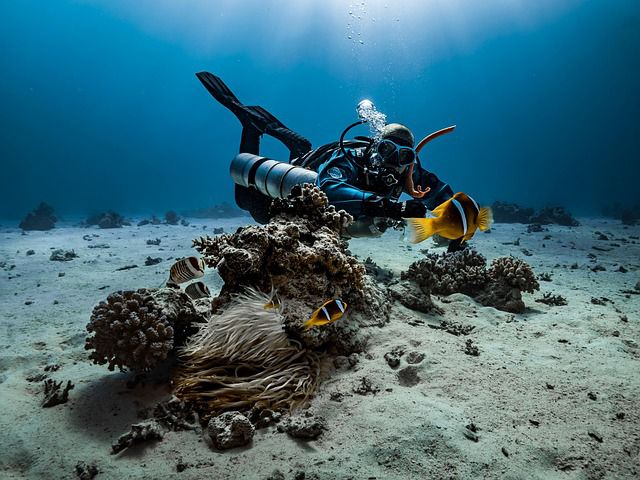
And then you are just there — weightless in a way that has no equivalent on land, breathing, looking at things.
In Beirut this happens over rock and reef along the Raouché coastline. What you will actually see: damselfish in clouds over the structure, bream and wrasse working the rock, a moray with its head out of a hole, and — if the guide is good and you are patient — an octopus, which will be invisible for ten seconds and then obvious. Full species guide.
Afterwards
You will be tired and hungry — diving is more physically demanding than it feels.
Do not fly for the interval your instructor gives you. If you are on a short trip, mention your flight when you book.
The minute-by-minute version of all of this is in your first dive, minute by minute.
What it does and does not qualify you for
| You can | Dive again on the same supervised basis |
| You can | Often credit the experience towards an entry-level course |
| You cannot | Rent equipment |
| You cannot | Dive without a professional supervising you |
| You cannot | Join ordinary certified fun dives |
If you want any of the bottom three, the next step is the Open Water course — three to four days, certification that never expires, and recognised worldwide.
If you are nervous
Say so when you book, and again to your instructor on the day.
It genuinely changes how the session runs — more surface time, a slower descent, a shallower dive, more checking in. Instructors far prefer knowing.
And for what it is worth: nervousness before a first dive is the norm, not the exception. Almost everyone who was frightened beforehand says afterwards that the anticipation was worse than the dive. The honest safety picture is in is diving safe?.
Practical details
When. June through October is the easiest window — warm water, settled sea. August is warmest; September and October are the best overall. Month-by-month.
What to bring. Swimsuit, towel, and any prescription information. If you wear glasses, mention it when you book — there are options. Everything else is provided.
Where. SEALS operates from inside Mövenpick Hotel Beirut on the Raouché seafront. Finding us.
How long. Two to three hours, so it fits inside a morning.
The honest sales pitch
Some people do a try-dive and never dive again, and that is a completely fine outcome — they had a good morning and answered the question.
Most people do it and immediately want to know about the course.
Either way, one morning is a very cheap way to find out which of the two you are.