Descriptions of a first dive tend to skip straight to the good part. The reality has a lot more paperwork in it, and the genuinely awkward moment happens somewhere nobody warns you about — in about a metre of water, before you have gone anywhere.
Here is the whole thing, in order.
Before you arrive
Sleep, eat something light, and do not drink the night before. Alcohol and dehydration both matter more underwater than they do on land.
Bring a swimsuit, a towel and any prescription information. If you wear glasses, mention it when you book — there are options and they are worth arranging in advance. More on that here.
Do not dive with a cold or blocked sinuses. This is the most common reason a first dive gets cut short. Congested ears cannot equalise, and a dive you cannot equalise on is a dive you cannot do.
0:00 — Arrival and paperwork
Expect twenty minutes of admin. Nobody mentions this and everybody is mildly surprised by it.
You will fill in a medical questionnaire. Answer it honestly. It exists to catch conditions that interact badly with pressure, and a "yes" on it does not automatically stop you diving — it usually just means a conversation, and occasionally a doctor's sign-off.
You will also sign a liability form. Read it rather than scanning it.
0:20 — The briefing
This is the part that determines whether the dive goes well.
You will be taught, on land or in shallow water:
- How to breathe from the regulator. Slowly, through the mouth. That is genuinely most of it.
- How to equalise your ears. Usually pinch your nose and blow gently, early and often, before it hurts.
- How to clear water from your mask. Which sounds alarming and takes about four seconds.
- Hand signals. OK, up, down, problem, and "ear trouble." Perhaps six of them.
- The rule that matters most: never hold your breath. Breathe continuously, always.
If you do not understand something, say so now. There is no way to ask a clarifying question at eight metres.
0:45 — Kitting up
The equipment is heavier than you expect and feels awkward on land. This is normal and it stops the moment you are in the water.
You will be wearing a wetsuit, a buoyancy jacket with a cylinder attached, a weight system, mask and fins. Total weight is significant on land, effectively nothing once you are floating.
Getting into a wetsuit is undignified. Everyone struggles. It is easier wet.
1:00 — In the water, standing up
This is the hard part. Not the depth. Here.
You will be in water somewhere between waist and chest deep, with a mask on your face and a regulator in your mouth, and you will be asked to put your face in the water and breathe.
Everything your body knows says do not do that.
Then you take one breath, and it works, and there is a specific moment — most divers remember it years later — where the objection simply stops. It is usually somewhere around the third or fourth breath.
1:10 — Shallow-water practice
Before you go anywhere you will practise, in water you can stand up in:
- Breathing normally on the regulator
- Clearing a little water out of your mask
- Recovering the regulator if it comes out of your mouth
- Equalising as you go slightly deeper
You stay here until it is comfortable. There is no timetable. A good instructor is watching your breathing rate more than the clock.
1:25 — The descent
Slow. Feet first, usually, holding a line or your instructor's arm.
Equalise early and often — every metre or so, before you feel pressure rather than after. If your ears do not clear, signal, go up half a metre, and try again. This is completely normal and happens to experienced divers.
The descent is where the noise changes. The surface disappears above you, your breathing becomes the loudest thing in the world, and everything slows down.
1:30 — The dive
And then you are just... there.
The first thing most people notice is that they are weightless in a way that has no equivalent on land. The second is that they are breathing too fast, and that consciously slowing down makes everything better.
Your instructor will be within arm's reach the entire time — usually holding your jacket, at least at first. You will swim gently. You will look at things. Someone will point at an octopus and you will not see it for about ten seconds, and then you will.
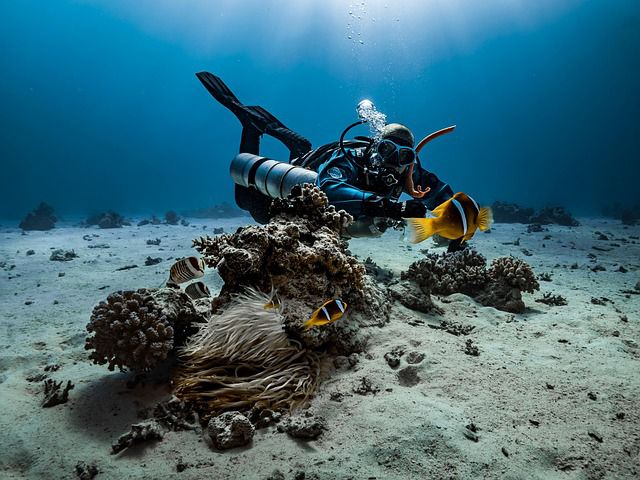
In Lebanon that first dive typically happens over rock and reef, and what you see is grouper, damselfish, wrasse, morays in the rock and — if the guide is good and you are patient — an octopus. Full species guide here.
The dive lasts as long as your gas and comfort allow: typically 20 to 40 minutes.
2:00 — Getting out
The gear is heavy again the moment you are out of the water. There is usually a ladder. It is less elegant than you would like, for everyone.
Then there is the part nobody warns you about: you will be very tired and quite hungry. Diving is more physically demanding than it feels, and thermal load plus breathing dense gas adds up. Eat something.
2:30 — Afterwards
Do not fly for the recommended interval afterwards. Your instructor will tell you what that is for the dive you did. It matters, and holiday flight schedules are a common way people get it wrong.
Drink water. Skip the strenuous exercise for the rest of the day.
And then, some hours later, you will find yourself looking up dive courses. This happens to a startling proportion of people. The next step, if it does, is the Open Water course.
The honest summary of the awkward parts
| Moment | How it actually feels |
|---|---|
| The paperwork | Longer than expected, mildly tedious |
| First face in the water | The hardest moment of the day |
| Mask on your face | Irritating if it does not fit; fine if it does |
| Equalising | Strange, then automatic |
| Descending | Slightly disorienting for about thirty seconds |
| Being at depth | Unexpectedly calm |
| Getting out | Ungainly, tiring |
| An hour later | Wanting to do it again |
If you are nervous
Say so when you book, and say so again to your instructor. It changes how the session is run — more surface time, a slower descent, a shallower dive, more checking in.
Anxiety about diving is extremely common and it is not a reason not to go. Hiding it is the only version of it that causes problems. We wrote about that properly in is diving safe?.
And if you cannot swim well, that is a separate question with a more interesting answer than you might expect: do you need to know how to swim to scuba dive?